
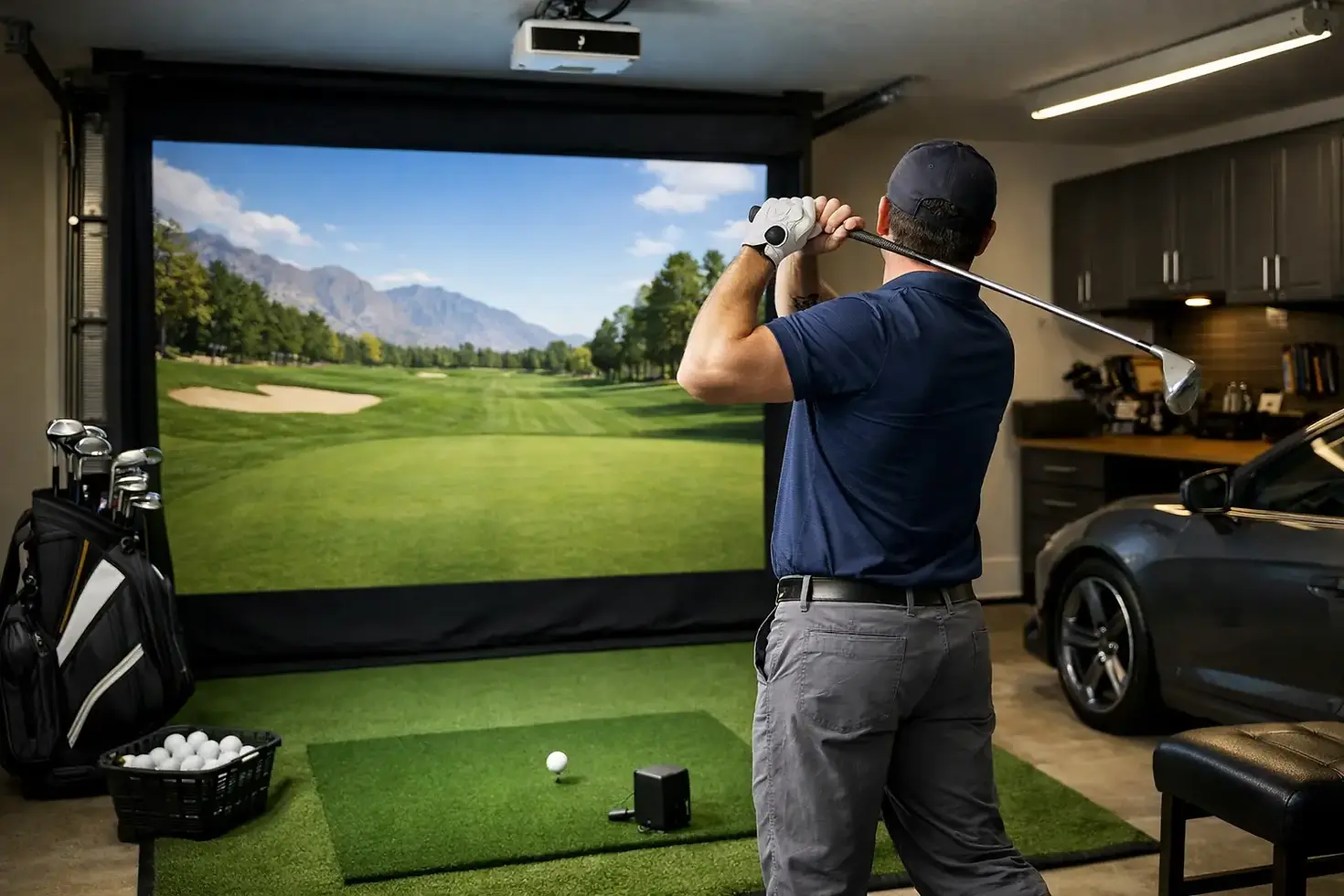
Do Simulators Work in Garages? Yes - If Fit

A garage can be one of the smartest places to put a golf simulator - and one of the easiest places to get wrong.
If you are asking, do simulators work in garages, the short answer is yes. In many homes, the garage offers the ceiling height, room depth, and privacy that a spare bedroom or basement cannot. But a good garage simulator depends on more than just squeezing a mat and screen between the walls. The details matter, especially if you want a setup that feels good to hit in, tracks accurately, and holds up over time.
Do simulators work in garages for real practice?
Yes, they can work extremely well for real practice, entertainment, or both. In fact, garages are often better than other spaces because they were built to handle open floor area, vehicle access, and flexible use. That extra footprint can make all the difference when you are trying to swing a driver comfortably or create a clean projector layout.
The catch is that garages come with their own challenges. Ceiling slopes, garage door rails, cold winter temperatures, concrete floors, and limited insulation can all affect performance and comfort. A garage simulator is not just about whether the unit fits. It is about whether the whole room supports the experience you want.
For some homeowners, a basic garage build is perfect. For others, the best result comes from modifying the space with a high-lift door, wall protection, improved lighting control, or climate management. That is why garage projects tend to benefit from custom planning instead of an off-the-shelf guess.
The first question is not the simulator - it is the space
Most people start by shopping for launch monitors, screens, and software. The smarter starting point is measuring the garage correctly.
Ceiling height is usually the biggest factor. Many golfers can swing comfortably in a garage with 9-foot ceilings, but not all can. Taller players or players with steeper swings often need more. If the goal is full-driver use without feeling restricted, 10 feet or more is ideal when available. Even if the tape measure says you have enough height, soffits, openers, lights, and door tracks can create problems right where the club travels.
Depth matters too. You need room for the hitting area, safe ball flight into the screen, and enough clearance behind the player for both swing comfort and accurate tracking. Width is often overlooked until a right-handed player realizes the wall is too close on the backswing. If left- and right-handed users will share the simulator, space planning becomes even more important.
This is where experience matters. A garage may technically fit a simulator on paper, but the right design makes the difference between a cramped compromise and a space you actually want to use three times a week.
Garage doors and openers can change everything
A standard overhead garage door setup is one of the most common obstacles in garage simulator design. The tracks and opener often sit exactly where you want your screen, projector, or swing path.
Sometimes the answer is simple. A jackshaft opener mounted on the wall can free overhead space. In other cases, a high-lift garage door conversion gives you the clearance needed for a proper enclosure. These changes are not cosmetic. They can be the reason a garage goes from almost workable to genuinely excellent.
If the garage still needs to function for vehicle storage, the design has to respect that too. Some homeowners want a permanent simulator. Others need a setup that shares space with cars, tools, or seasonal storage. Both are possible, but they require different equipment choices and a different installation approach.
Comfort matters more in a garage than people expect
A simulator that is technically usable but uncomfortable will not get much use.
Garages are often colder in winter, hotter in summer, and louder than finished interior rooms. For buyers in colder states, this can be the biggest issue. Launch monitors and projectors also perform best in stable conditions, and your body does too. If you are swinging in a 38-degree garage, practice gets old fast.
Heating, insulation, and air movement deserve attention early in the planning stage. Sometimes a quality space heater and insulation upgrades are enough. In other projects, a mini-split system is the better long-term answer. Flooring matters as well. Concrete is durable, but standing and swinging on it without the right surface is hard on joints and not ideal for a premium simulator experience.
A well-designed garage simulator should feel intentional, not temporary. That means thinking about temperature, sound, lighting, and underfoot comfort just as seriously as launch monitor specs.
Lighting and flooring affect performance
Garages often have lighting that is fine for parking a car and terrible for simulator use. Too much ambient light can wash out a projected image. Poor fixture placement can interfere with sensors or create visual distraction at address.
The fix is usually straightforward, but it should be planned. Controlled lighting zones, better fixture placement, and projector-friendly conditions can dramatically improve the look and feel of the room.
Flooring is just as important. A proper hitting strip, stance mat, and level hitting area help protect your body and improve consistency. If the floor slopes toward the garage door, as many do, leveling solutions may be required. That detail is easy to miss and hard to ignore once you start hitting balls.
Technology choice depends on the garage layout
Not every simulator technology works the same way in a garage.
Some launch monitors need more ball flight. Others perform well in tighter spaces. Some are more tolerant of lighting conditions, while others require more control over the environment. Ceiling-mounted options can be excellent in a garage, but only if the structure and clearances support proper placement. Floor-based units can be a strong fit too, especially when flexibility matters.
This is one reason premium, custom-configured systems tend to outperform one-size-fits-all packages. The right answer depends on your dimensions, player profile, budget, and whether the simulator is mainly for serious practice, family entertainment, or mixed use.
For commercial garage-style spaces - such as outbuildings, training facilities, or converted service bays - durability and repeatability matter even more. The system has to handle traffic, maintain accurate performance, and look polished enough to support the customer experience.
What usually makes a garage simulator successful
The best garage builds share a few traits. They respect the actual dimensions of the space, not idealized ones. They solve for comfort, not just fit. And they use equipment that matches the room instead of forcing the room to work around the wrong equipment.
That often means careful planning around five things: ceiling clearance, door configuration, climate control, floor leveling, and technology placement. When those are handled properly, a garage can become one of the most practical and impressive simulator locations in a home.
It can also be one of the best values. Many homeowners already have the square footage. Instead of finishing an entirely new addition or repurposing prime indoor living space, they can transform an existing area into a year-round golf environment. For some buyers, that makes the garage the most efficient path to a premium simulator.
When a garage may not be the right fit
There are cases where a garage is not the best answer.
If ceiling height is too tight for a comfortable swing, if the door system cannot be modified, or if the space is exposed to severe temperature swings without a realistic plan to manage them, another room may make more sense. A basement, bonus room, or commercial unit may provide a better long-term result.
The key is being honest about the trade-offs. A garage simulator should not feel like a compromise every time you step in to practice. If the room creates constant limitations, the better investment may be choosing a different location or adjusting the project scope.
That said, many garages that seem questionable at first can work very well after a professional design review. We have seen spaces become high-performance simulator rooms simply by reworking the door system, choosing the right launch monitor, and building around the room's strengths instead of fighting its weaknesses.
At Green Pro Golf Simulators, that is exactly where smart planning pays off. The goal is not to sell a box of parts. It is to create a simulator that works in your space, fits your goals, and feels worth the investment every time you use it.
A garage is rarely perfect on its own. But with the right design, it can be one of the best places in the house to practice, play, and make golf part of your daily routine.


Comments