

Is a Trackman Simulator for Home Worth It?

A trackman simulator for home is one of the few golf purchases that can genuinely change how often you practice, how well you understand your swing, and how much use a room gets year-round. But it is also a serious investment, which means the right question is not simply whether Trackman is good. It is whether Trackman makes sense for your space, your goals, and the way you actually plan to use the simulator.
For some buyers, it is the clear top-tier choice. For others, another premium system may deliver a better fit at a lower cost or with fewer installation limitations. That is where smart planning matters.
What makes a Trackman simulator for home different?
Trackman has built its reputation on radar-based ball and club tracking, trusted by tour players, coaches, fitters, and serious amateurs who want highly detailed feedback. In a home setting, that reputation matters because buyers are usually trying to accomplish more than one thing at once. They want accurate data, realistic course play, reliable software, and a setup that feels polished enough to use often.
What separates Trackman from many systems is the combination of performance and brand confidence. If your priority is training with the kind of data platform used at the top levels of golf, Trackman carries real weight. It is especially attractive for players who care about measured numbers, structured practice, and long-term skill development rather than casual entertainment alone.
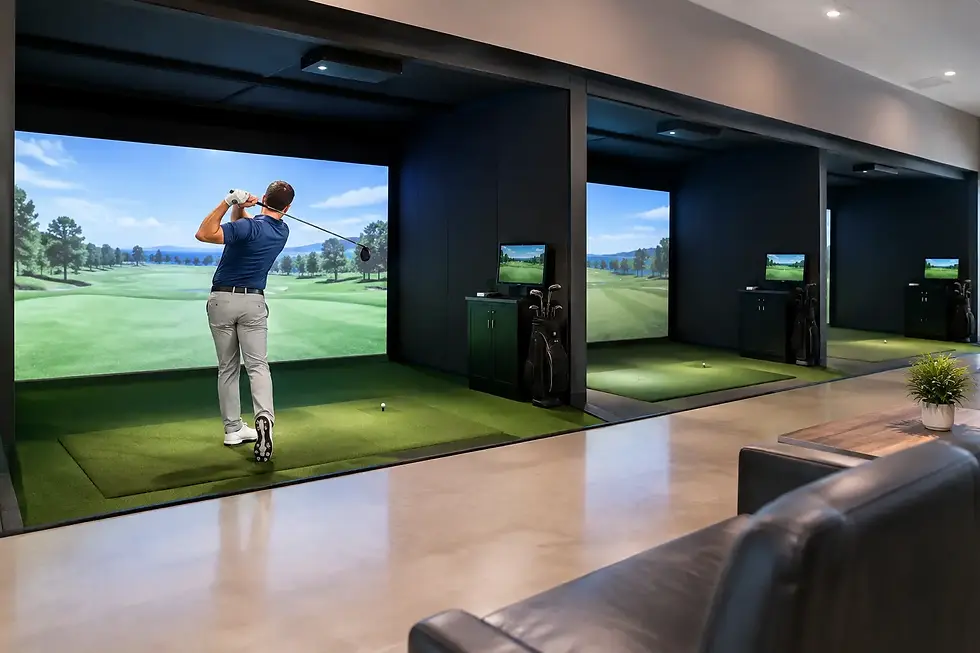
That said, premium performance only pays off if the room supports it. A simulator is never just a launch monitor sitting in a box. It is a full environment made up of the tracking system, enclosure, screen, projector, hitting area, computer hardware, and room design. The quality of the overall build determines whether the experience feels first-class or frustrating.
Who should consider Trackman at home?
Trackman tends to make the most sense for buyers who take golf seriously and want their home simulator to perform like a professional training tool. That includes low handicaps, competitive juniors, club champions, coaches, and golfers who simply want top-tier feedback whenever they practice.
It can also be a strong fit for homeowners building a premium entertainment space. A dedicated golf room with high-end finishes, course play, and multiplayer use has obvious appeal beyond pure practice. If the budget is there, Trackman can be both a training asset and a centerpiece for the room.
Where buyers sometimes get off track is assuming the most recognized brand is automatically the right answer. If your main goal is family entertainment, occasional range sessions, and some winter golf in the garage, a different premium system may be more practical. The best outcome comes from matching the technology to the use case, not forcing the use case to justify the technology.
Space requirements matter more than most buyers expect
When people ask about a Trackman simulator for home, the conversation usually starts with accuracy and cost. In practice, room dimensions are often the deciding factor.
Trackman systems need proper ball flight and device positioning to perform at their best. That means ceiling height, room depth, room width, and hitting position all need to be evaluated carefully. A setup that looks workable on paper can still feel cramped once you account for the golfer’s swing, the enclosure footprint, safety buffer, screen placement, and the radar unit itself.
This is why custom design matters. Basements, garages, bonus rooms, and outbuildings all come with different constraints. A garage might offer plenty of depth but create HVAC and insulation issues. A basement may be ideal for year-round use but create challenges with ceiling height or support beams. A dedicated addition can be excellent, but it requires planning the simulator early enough that lighting, power, flooring, and projector placement are all built around the system.
The point is simple: premium hardware deserves a room designed to support it. Otherwise, you risk paying for performance you cannot fully use.
What does the full home build actually include?
A lot of buyers focus on the launch monitor itself, but the simulator experience depends on the complete package. With a Trackman-based room, the build typically includes the launch monitor, an impact screen and enclosure, a quality hitting mat, a projector, a gaming-capable computer, and finishing details that make the room comfortable and durable.
Those finishing details are not minor. Turf transitions, wall protection, acoustics, lighting control, and cable management all affect how often the simulator gets used. So does image quality. A premium launch monitor paired with a weak projector or a poorly sized screen creates a mismatch that drags down the experience.
This is one reason turnkey planning has so much value. The best home simulators are built as systems, not assembled as a pile of separate products.
Cost: the honest answer
A Trackman home simulator is a premium investment. Buyers should expect the total cost to extend well beyond the launch monitor itself once you include enclosure materials, projector, computer, screen, mat, installation, and any room prep.
The final number depends heavily on the room and the finish level. A straightforward garage or basement build will cost less than a fully finished custom simulator room with upgraded aesthetics, integrated seating, and architectural work. It also depends on whether the space already has the right dimensions, electrical access, internet stability, and climate control.
This is where experienced guidance saves money. Not by cutting corners, but by avoiding mismatched equipment, unnecessary upgrades, and design mistakes that are expensive to fix later. The cheapest path upfront often becomes the more expensive one after rework.
Is Trackman the best option for every home?
No, and that is not a knock on Trackman. It is just the reality of matching technology to the buyer.
For some spaces, another premium launch monitor may fit better based on room dimensions or player preferences. For some households, the ideal system is one that balances strong data with easier installation requirements or a lower total budget. For others, the decision comes down to whether the simulator will be used mostly for deep practice, casual rounds with friends, or a mix of both.
A good design partner should be willing to say that out loud. If Trackman is the right fit, there should be a clear reason. If another system is better for your room, your budget, or your intended use, that should be part of the recommendation too.
The value of professional design and installation
The biggest risk in a high-end simulator project is not buying quality equipment. It is buying quality equipment without a complete plan.
Professional design helps you answer the questions that matter before money gets spent. Will the room safely fit right- and left-handed players? Is the projector positioned to avoid shadows? Does the hitting area line up correctly with the screen? Will the computer support the software smoothly? Is the enclosure sized for the room instead of forced into it?
Installation matters just as much. A simulator should feel intentional, clean, and dependable from day one. That means proper mounting, calibration, finish work, and support after the build is complete. For buyers making a meaningful investment, confidence in the process is part of the product.
That is why many homeowners choose a full-service partner rather than trying to source everything piece by piece. Companies like Green Pro Golf Simulators help buyers avoid the trial-and-error phase and move straight into a room that performs the way it should.
When a Trackman home simulator is worth it
A Trackman setup is worth it when you know you will use the performance, when the room can support the technology properly, and when the build is designed around your goals. If you want tour-level credibility, detailed practice feedback, premium course play, and a home space that feels like a real golf environment, it can be an outstanding long-term investment.
If your needs are lighter, that is fine too. The smartest buyers are not the ones chasing the biggest name. They are the ones building the right simulator for how they live, play, and practice.
The best first step is not choosing hardware. It is understanding your space, your budget, and what success actually looks like once the room is finished. From there, the right system usually becomes much easier to see.


Comments