

Best Golf Simulator Flooring for Real Use

A simulator can have elite launch monitor data, a sharp projector image, and a clean enclosure, yet still feel unfinished the moment you step onto the wrong surface. The best golf simulator flooring does more than make a room look polished. It affects comfort, stance stability, joint stress, noise, durability, and how naturally the space plays for everyone using it.
Flooring is one of the most overlooked parts of a simulator build because buyers tend to focus on the screen, software, and hitting mat first. That makes sense, but flooring is what ties the room together. If the floor is too hard, too slick, too thin, or uneven with the mat, the entire experience suffers. For a home build, that can mean sore knees, awkward footing, and a room that never quite feels complete. For a commercial installation, it can mean faster wear, higher maintenance, and a less professional impression.
What the best golf simulator flooring needs to do
Good simulator flooring has a simple job on paper and a demanding one in practice. It needs to create a clean, safe, attractive surface while supporting repeated swings, foot traffic, and equipment use. It also needs to work with the hitting area rather than compete with it.
The first priority is level integration with the hitting mat. If your mat sits noticeably higher than the surrounding floor, players constantly step up and down, which feels awkward and can even affect setup. A flush or near-flush transition creates a better stance and a more finished look.
The second priority is comfort. Most simulator sessions last longer than people expect. Practice turns into another bucket, then a few holes, then a full round with friends. Hard concrete under thin turf gets old fast, especially in garages and basements.
The third priority is durability. Flooring in a simulator room has to handle shoes, dropped clubs, rolling seats, launch monitor placement, and in some spaces, food and beverage traffic. Residential buyers may be able to prioritize appearance a bit more. Commercial operators usually need to lean harder into wear resistance and ease of replacement.
Best golf simulator flooring options
There is no single flooring material that wins every project. The best choice depends on room use, budget, and whether the simulator is mostly for serious practice, family entertainment, or constant public traffic.
Turf flooring
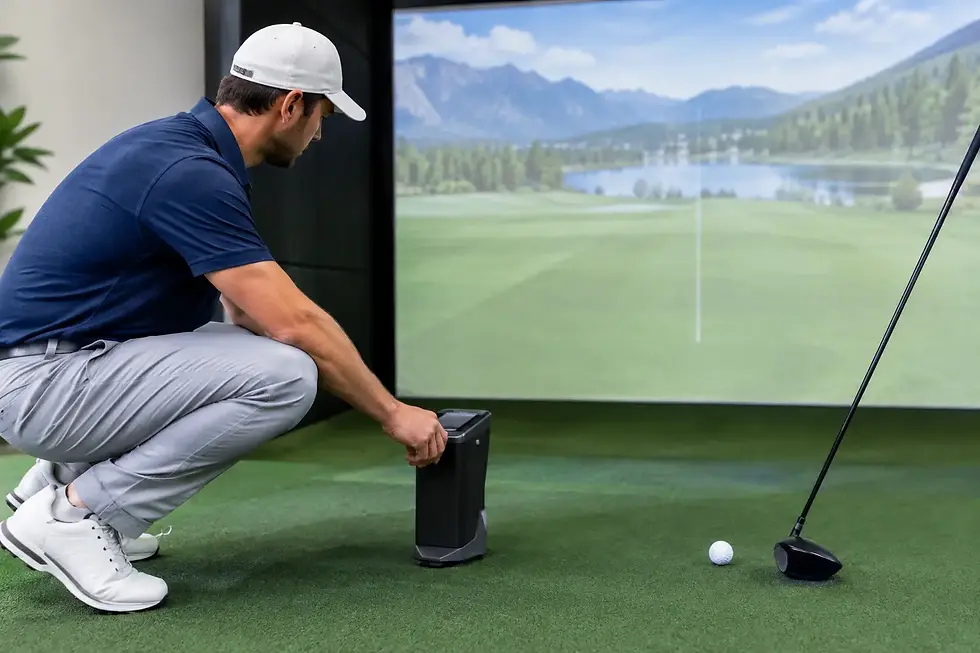
For many installations, padded turf is the leading choice. It gives the room a true golf look, softens the feel underfoot, helps absorb sound, and creates a natural visual transition around the hitting mat. In a dedicated simulator room, turf usually delivers the most complete finish.
That said, not all turf is equal. Cheap turf can flatten quickly, show seams, or feel plastic underfoot. Premium turf with the right pile height and backing performs much better, especially when paired with quality underlayment. The result is a cleaner appearance and a room that feels intentional instead of improvised.
Turf is especially strong for homeowners who want the space to feel like a real golf environment. It also works well in commercial spaces that want a premium look, though high-traffic venues need commercial-grade material designed for repeated use.
Rubber flooring
Rubber flooring is practical, durable, and easy to maintain. It holds up well in commercial applications, training environments, and multipurpose rooms where golf is only one of several functions. It also offers strong traction and a solid, stable feel.
The trade-off is appearance. Rubber flooring can look more utilitarian than turf, which may be fine in a teaching bay or performance studio but less ideal in a high-end residential build. Some buyers also find it less comfortable for long sessions unless there is enough cushion underneath.
Rubber becomes a smart option when durability and simple maintenance matter more than creating a golf-course aesthetic.
Foam tiles with turf overlay
This is a common mid-range solution, particularly in home projects. Interlocking foam tiles create cushion and help with minor floor irregularities, while a turf layer on top improves appearance. When done well, this setup can look good and feel comfortable without pushing the budget too far.
The key phrase is when done well. Lower-quality foam systems can shift, compress unevenly, or create visible movement over time. In lighter-use home setups, that may be acceptable. In serious practice spaces or commercial environments, it often becomes a weak point.
Carpet
Carpet is usually the least golf-specific option, but it appears in some multipurpose rooms and finished basements. It can reduce noise and make a room feel warm, but it is rarely the best golf simulator flooring if performance and longevity are the goal.
Carpet wears unevenly around the hitting area, can be difficult to keep clean, and generally does not create the professional finish most buyers want. It works better as a compromise in shared-use spaces than as a purpose-built simulator solution.
The subfloor matters more than most people expect
One reason flooring decisions go wrong is that buyers focus on the visible surface and ignore what sits below it. In simulator construction, the subfloor often determines how comfortable and stable the room feels.
Concrete is the most common base in garages, basements, and commercial spaces. It is solid, but unforgiving. Installing turf directly over concrete may save money upfront, yet the feel underfoot often disappoints. Adding the right underlayment or platform system can dramatically improve comfort, reduce noise, and create better height matching with the hitting mat.
Wood subfloors are more forgiving but still need planning. Depending on the flooring material, you may need an additional layer for stability, moisture management, or noise reduction. If the room has any slope, which is common in garages, leveling becomes a serious consideration. A simulator floor that looks flat but plays slightly off can be frustrating over time.
Matching flooring to the hitting mat
The flooring and hitting mat should be selected together, not separately. This is where many DIY projects lose their polished look. A premium mat dropped onto mismatched flooring often creates a visible edge and a disconnected feel.
Ideally, the surrounding floor should support the same stance height as the mat or be built to transition smoothly into it. That makes address position feel natural whether the player is on the mat, stepping around the bay, or rotating through practice drills.
This matters even more in larger builds with custom tee lines or integrated putting turf. The room should function as one playing surface, not a collection of separate pieces.
Home builds versus commercial installs
Residential and commercial buyers should not approach flooring the same way.
In a home simulator, comfort and appearance usually carry more weight. People want a room that feels premium, photographs well, and makes them want to spend time there. Turf with proper padding is often the strongest fit because it delivers both visual impact and day-to-day comfort.
In a business setting, durability and maintenance rise to the top. Bars, restaurants, golf courses, schools, and 24/7 facilities need flooring that stands up to constant use and remains presentable without constant repair. That may mean heavier-duty turf, rubber in selected areas, or a hybrid solution based on traffic patterns.
It also depends on the business model. A private teaching studio has different flooring needs than a social entertainment venue. One is optimized for instruction and repeated swings. The other may need to balance golf performance with spills, foot traffic, and furniture movement.
Common mistakes when choosing simulator flooring
The most common mistake is buying based on appearance alone. A floor can look sharp online and still feel poor in person. Texture, density, rebound, and cushion all matter.
Another mistake is underestimating thickness. If the flooring is too thin, the room feels hard and unfinished. If it is too thick without proper planning, it can create issues with door clearance, screen geometry, or mat height.
The third mistake is treating flooring like an accessory instead of part of the build. In quality simulator design, flooring affects both performance and presentation. It should be planned alongside the enclosure, launch monitor, projector placement, room dimensions, and player use case.
So what is the best golf simulator flooring?
For most dedicated simulator rooms, the best golf simulator flooring is premium turf paired with the right padding or subfloor system and matched carefully to the hitting mat height. It offers the best blend of golf look, comfort, acoustics, and finished-room appeal.
That answer changes when the room has heavier traffic, multiple uses, or a tighter budget. Rubber can be the smarter call for some commercial applications. Foam-and-turf systems can work for selected home builds. Carpet usually lands last unless the simulator is a secondary use in an already finished space.
The real goal is not picking a material in isolation. It is choosing a flooring system that fits the room, supports the way people will actually use it, and makes the simulator feel complete from the ground up. That is where expert planning pays off. Companies like Green Pro Golf Simulators look at the entire room, not just the equipment list, because the best builds are the ones that play well, look right, and hold up long after installation day.
If you are investing in a simulator, treat the floor like part of the experience, not an afterthought. You will feel the difference every time you step in to hit.


Comments