

Are Golf Simulators Accurate? What to Expect

A golfer hits a 7-iron indoors, sees a carry number that matches the course, and immediately trusts the system. Another hits the same club on a bargain setup and watches a soft fade turn into a pull-hook on screen. That gap is why so many buyers ask, are golf simulators accurate?
The honest answer is yes, many are very accurate, but accuracy depends on the technology, the room, the installation, and the expectations. A premium simulator can produce shot data that is reliable enough for serious practice, club fitting, lessons, and year-round play. A lower-end or poorly installed system can still be fun, but it may not give you the level of precision needed to make real swing decisions.
Are golf simulators accurate enough for real practice?
For most golfers, the answer is absolutely yes - if the system is built correctly and uses quality launch monitor technology. The best simulators measure or calculate core ball and club data such as ball speed, launch angle, spin, club path, face angle, and carry distance with impressive consistency.
That matters because good practice depends on truthful feedback. If your simulator shows the same launch window, spin profile, and shot shape you see outdoors, you can work on mechanics with confidence. If the numbers are inconsistent, every session becomes guesswork.
This is where premium systems separate themselves from entry-level options. Serious golfers usually want a simulator that helps them improve, not just entertain guests. Commercial operators need something even more demanding. If customers are paying by the hour, the ball flight needs to feel believable and the data needs to hold up over repeated use.
What affects golf simulator accuracy?
Simulator accuracy is not just about buying a well-known brand. The full environment plays a role.
Launch monitor technology
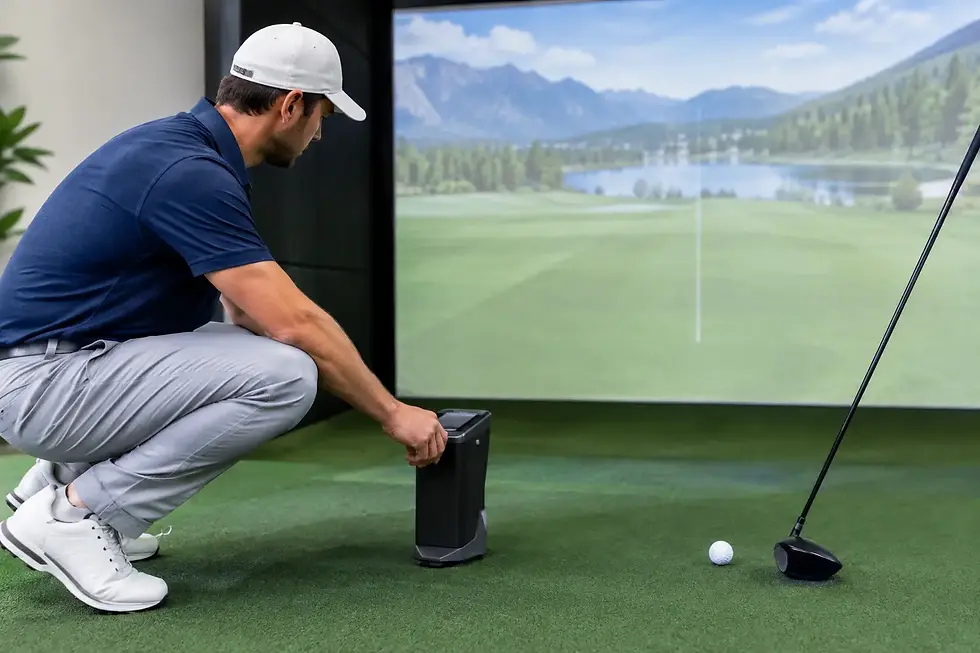
The launch monitor is the heart of the system. Some units use high-speed cameras, some use radar, and some combine methods. Camera-based systems tend to excel indoors because they directly capture impact and early ball flight in a controlled space. Radar-based systems can also perform very well indoors, but they often need enough room depth to read the shot properly.
Neither approach is automatically better in every room. The right choice depends on ceiling height, ball-to-screen distance, available depth, left- or right-handed use, and whether the main goal is practice, entertainment, teaching, or commercial traffic.
Room dimensions and layout
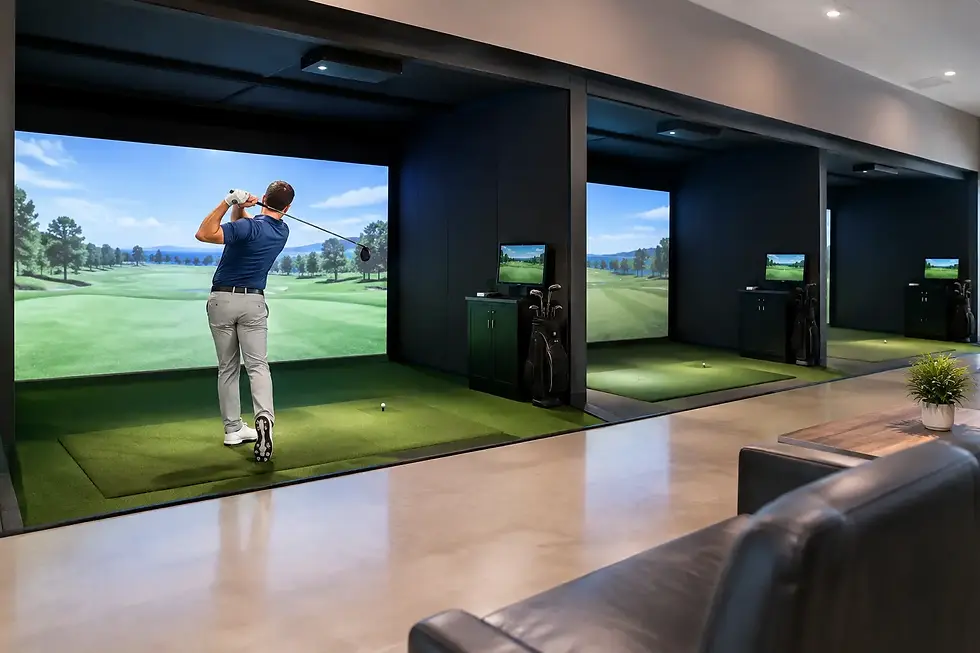
A simulator can only be as good as the space allows. If the ceiling is too low, golfers alter their swing. If the hitting area is cramped, the launch monitor may not sit in the ideal position. If the projector placement or screen offset is wrong, the visual experience can feel off even if the shot data is solid.
That is why custom design matters. A simulator installed in a garage, basement, school facility, or bar is not a plug-and-play product. The system has to fit the space so the technology can do its job.
Calibration and installation
A premium launch monitor still needs proper setup. Alignment, hitting zone placement, turf height, screen distance, lighting, and software settings all affect performance. Small installation mistakes can create frustrating shot reads, especially on wedges, high-spin shots, or mis-hits.
This is one of the biggest differences between buying equipment and getting a complete simulator solution. Professional installation helps make sure the system performs the way the manufacturer intended.
Ball quality and hitting surface
Range balls, worn balls, and inconsistent turf can all change what the simulator sees. If the dimples are damaged or the surface causes the club to interact differently than expected, the data can shift. Premium simulator setups usually perform best with clean, quality golf balls and a hitting surface that supports consistent contact.
How accurate are premium golf simulators compared to outdoor play?
The best way to think about it is this: premium golf simulators are highly accurate at measuring launch conditions, and those launch conditions drive realistic ball flight. In many cases, carry distance and shot shape are close enough to outdoor results that players can practice with real purpose.
Where differences can show up is in environmental and sensory factors. Indoors, you do not feel wind, uneven lies, temperature changes, or visual depth the same way. Some golfers also swing differently inside, especially early on. That is not a simulator flaw. It is an indoor performance adjustment.
This is why accuracy should be judged in context. If a system consistently shows that your 8-iron launches at a certain angle, spins within a normal range, and carries a repeatable number, that is extremely useful. You do not need a simulator to recreate every outdoor variable perfectly to make it valuable. You need it to give you trustworthy data and realistic feedback.
Are golf simulators accurate for putting and short game?
This is where expectations need more nuance. Full-swing accuracy is generally stronger than putting realism across most simulator systems. Chipping and pitching can be very good on premium platforms, especially when the software and sensors are tuned well. Putting is improving, but it still varies more from system to system.
For some buyers, that barely matters. If the main goal is game improvement, club gapping, winter practice, lessons, or customer entertainment, full-swing performance is usually the priority. For others, especially facilities focused on league play or full-course realism, short-game performance should be part of the buying decision.
A good simulator partner will help you match the system to the experience you actually want, not just the feature list on paper.
Cheap vs premium systems: where accuracy changes
Most shoppers are not really asking whether simulators work. They are asking whether a lower-cost setup will feel close enough to justify the investment.
In general, lower-cost systems can be enjoyable and useful for casual play. They may estimate more data points rather than directly measure them, and that can be fine for entertainment. The trade-off is that shot shape, spin, and distance control may be less precise, especially for better players.
Premium systems usually provide stronger sensor technology, better software refinement, more reliable reads, and more consistent results over time. They also tend to integrate better with quality enclosures, projectors, computers, and hitting surfaces, which improves the overall experience.
For homeowners building a serious practice space, that difference can be worth it. For commercial buyers, it often is worth it because customer trust, repeat bookings, and system uptime matter just as much as graphics.
How to tell if a simulator will be accurate in your space
The smartest question is not just are golf simulators accurate, but will this simulator be accurate in my room for the way I plan to use it?
Start with the use case. A low-handicap player working on distance control has different needs than a family creating a multipurpose entertainment room. A golf bar needs durability and broad user appeal. A school or training center may need dependable data for coaching and player development.
Then look at the room itself. Ceiling height, width, depth, lighting, and player handedness all influence what technology will perform best. That is why custom planning matters so much. The right simulator on paper can become the wrong simulator if the room layout is ignored.
At Green Pro Golf Simulators, this is where a custom approach pays off. Matching launch monitor technology, enclosure design, projector performance, and computer hardware to the actual space leads to better accuracy, better reliability, and a better long-term investment.
What accuracy really means for buyers
If you are buying for your home, accuracy means you can practice with confidence after work, during winter, or whenever the course is closed. It means the numbers help your game instead of confusing it.
If you are buying for a business, accuracy means customers believe what they see. That trust leads to repeat play, stronger reviews, and a more professional experience. People do not need every shot to be perfect, but they do need the simulator to feel fair, consistent, and credible.
That is the standard worth aiming for. Not perfection in a marketing sense, but a well-built system that delivers dependable shot data, realistic play, and a setup designed around your space rather than forced into it.
If you are considering a simulator, the best next step is to think beyond the headline question. Accuracy is real, but only when the technology, design, and installation all work together. Get that part right, and an indoor simulator becomes more than a screen and a mat - it becomes a practice tool, an entertainment asset, and a year-round golf solution you will actually use.

Comments